
Version: 2.5.3 | Release: May 2026 | OS: macOS 11.0+
UPDF 2 – AI-Powered PDF Editor 2.5.3 for Mac
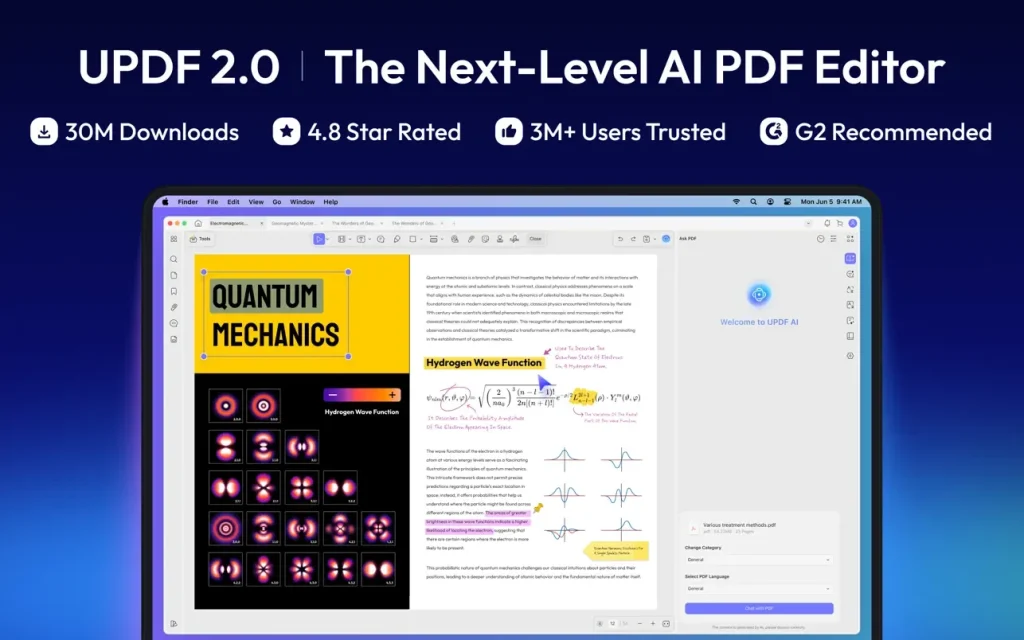
UPDF is a comprehensive AI-powered PDF editing software that can be used for AI chat with PDFs, editing, annotating, converting PDFs, and more. A single UPDF license allows use on all platforms, including macOS/iOS/iPadOS (universal purchase).
FUNCTIONS:
## AI Assistant
- – UPDF Powered by GPT-4.1 and Full DeepSeek (R1).
- – AI chat with your PDF for summarizing, translating full PDFs without format loss, and getting PDF-related answers.
- – Convert PDF files to mind maps.
- – Interact with images and ask any questions about images.
- – Ask any questions and get answers from AI.
## Editing PDF files
- – Edit text in PDF files to change text properties such as color, font, size, etc.
- – Edit images in PDF files to resize, crop, rotate, extract, replace, delete, etc.
- – Adding or removing links to a website or page.
## Annotating PDF Files
- – Highlight, underline, strikethrough, or wavy text in PDF files.
- – Add notes, text boxes, text comments, text callouts, or shapes to PDF files.
- – Hand drawing in PDF files.
- – Add stamps, stickers and signatures to PDF files.
- – Measuring PDF files.
## Converting PDF files
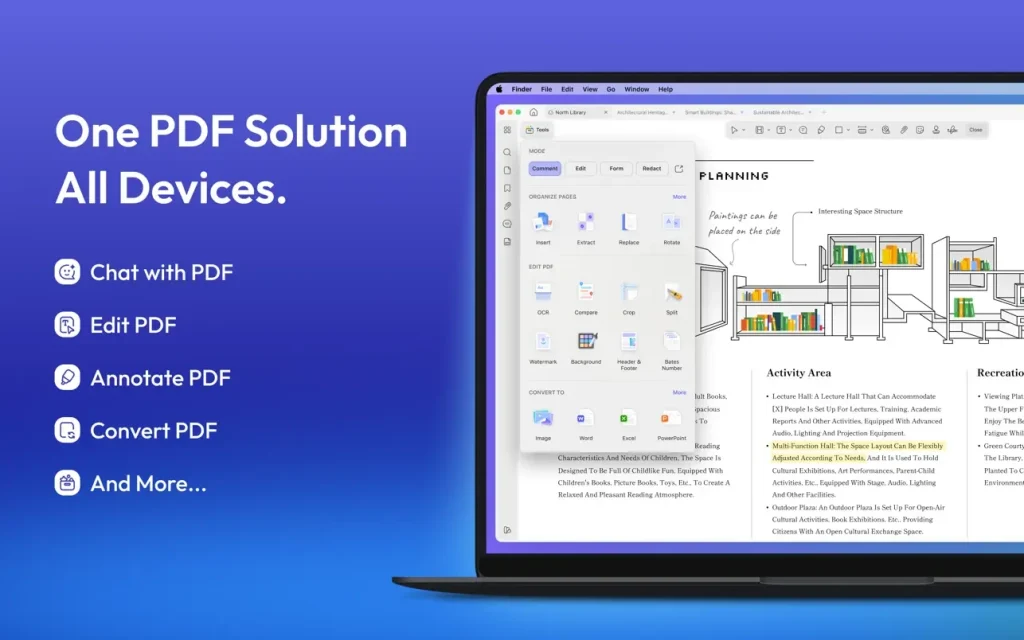
- – Convert PDF files to: DOCX, XLSX and PPTX.
- – Convert PDF files to images: PNG, JPEG, BMP, TIFF and GIF.
- – Convert PDF files to TXT, RTF, CSV, HTML and XML.
## Organize PDF pages
- – Insert, replace, extract, split, rotate, delete, and rearrange pages in PDF files
- – Crop or expand page margins.
- – Divide a long page into several pages.
## Protect PDF files
- – Add an open password or permissions to protect PDF files from being opened, copied, edited, and printed.
## Preparing the form
- – Create fillable PDF forms by adding interactive form fields.
- – Fill out PDF forms and add an electronic signature.
- – Add digital signatures to verify the sender’s identity.
## Batch processing of PDF files
- – Support batch processing to convert, merge, OCR, compress, print, create, insert and encrypt PDF files
- – Batch add or remove backgrounds, watermarks, headers and footers, and Bates numbers across multiple PDF files
- – Batch removal of text markup, measurements, stamps, form fields and signatures.
## Reading and printing PDF files
- – View PDF files one or two pages at a time/scroll.
- – Text to speech conversion.
- – Search and find text.
- – PDF slideshow.
- – Support for light and dark mode.
- – Adding and managing bookmarks.
- – Print PDF files.
## Creating PDF files
- – Create blank PDF file with different backgrounds or from Word/Excel/PPT/Image/CAJ/Paperwork/Selection Capture/Window Capture/Screen Capture/Clipboard/Scanner.
MORE:
- – Compare PDF files.
- – Editing confidential information in PDF files.
- – Add, edit or remove watermarks from PDF files.
- – Edit background for PDF files.
- – Editing header and footer in PDF files.
- – Save as PDF/A.
- – Smoothing of PDF files.
- – Send PDF files via link, QR code or email.
Compatibility: macOS 11 and later – ARM , x86 (64-bit)
Homepage https://updf.com/
Screenshots
Installation & Troubleshooting FAQ 7 questions
Common issues when installing macOS apps
How do I disable SIP and grant Terminal Full Disk Access?
System Integrity Protection (SIP) shields core macOS files from modification. Some patched apps and installers need SIP disabled temporarily.
Boot into Recovery Mode (hold Cmd+R), open Terminal from Utilities, run csrutil disable and restart.
macOS also blocks Terminal from protected folders until Full Disk Access is granted. Go to System Settings → Privacy & Security → Full Disk Access and toggle Terminal on.
How to disable Gatekeeper and remove quarantine?
Gatekeeper and quarantine can stop modified apps with “damaged” or “unidentified developer” warnings.
To disable Gatekeeper: sudo spctl --master-disable
To remove quarantine from a specific app: xattr -rd com.apple.quarantine /Applications/AppName.app
What to use instead of Launchpad on macOS 26?
Launchpad changed in macOS 26, so opening and organizing apps works differently.
Use Spotlight (Cmd+Space) to search and launch any app instantly. Third-party launchers like Alfred or Raycast are also excellent alternatives. You can also pin frequently used apps directly to your Dock for one-click access.
Why do I see security warnings when opening an app?
“App Not Downloaded from Mac App Store” — macOS blocks the app when security settings only allow App Store downloads. Go to Privacy & Security and permit apps from identified developers.
“Unidentified developer” — apps not registered with Apple trigger this on first launch. Use Control-click → Open to add a one-time security exception.
“Cannot verify for malicious software” — use Open Anyway in Privacy & Security to approve the app once.
What if the app is damaged or disk image is corrupted?
“App is damaged and can’t be opened” — quarantine flags or post-download changes trigger this error. Fix it with: xattr -cr /Applications/AppName.app
“Disk image corrupted” — incomplete or interrupted downloads often cause corrupted DMG errors. Use a download manager with resumable downloads to get a clean installer file.
How to fix Adobe app installation errors?
Adobe Creative Cloud local installers may fail from the GUI — right-click Install, open Contents/MacOS, and run the Unix executable manually to start the setup.
Adobe Error 1 (Rosetta required) appears on Apple Silicon when Rosetta is missing. Install it with: /usr/sbin/softwareupdate --install-rosetta --agree-to-license
CCXProcess install errors mean Creative Cloud cannot run Intel code on Apple Silicon without Rosetta — install Rosetta the same way, then retry.
Why can’t I install this app on an Intel Mac?
Some releases support only Apple Silicon (M1, M2, M3 and newer) and cannot install on Intel Macs due to architecture mismatch.
Look for universal builds or older releases matched to your processor. Tools like Adobe Activation Tool, QiuChenly, or RiD may offer Intel-compatible versions.
